- UnisaIR Home
- →
- Unisa Creative Outputs
- →
- Visual Arts
- →
- Art Exhibitions
- →
- View Item
JavaScript is disabled for your browser. Some features of this site may not work without it.
| dc.contributor.author | Mosako, Daniel Rankadi
|
|
| dc.contributor.author | Mosako, Daniel Rankadi
|
|
| dc.date.accessioned | 2026-09-13T21:59:11Z | |
| dc.date.available | 2026-09-13T21:59:11Z | |
| dc.date.issued | 2023-06-10 | |
| dc.identifier.citation | https://www.unisa.ac.za/sites/corporate/default/Colleges/Human-Sciences/News-&-events/Articles/Unisa-Art-Gallery-presents-exhibition-celebrating-the-universitys-rich-heritage | en_US |
| dc.identifier.uri | https://ir.unisa.ac.za/handle/10500/33049 | |
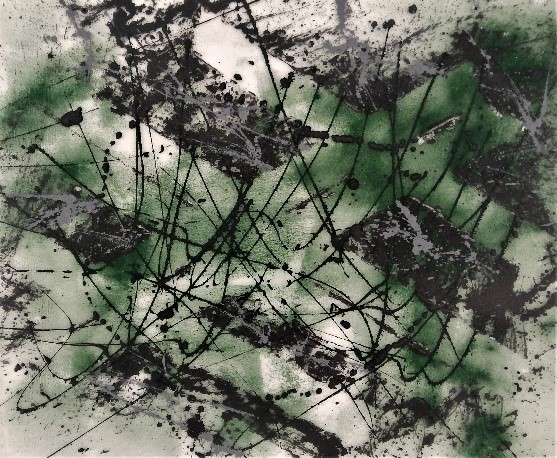
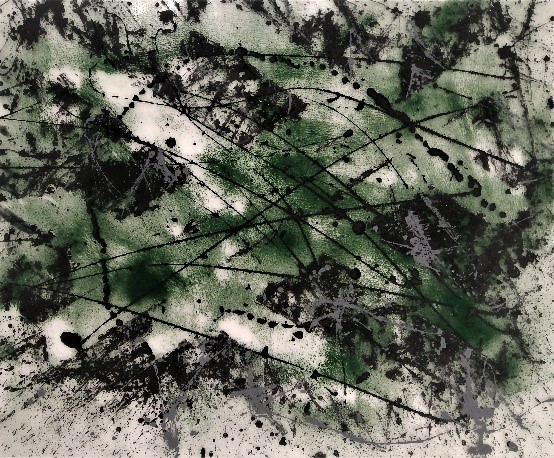
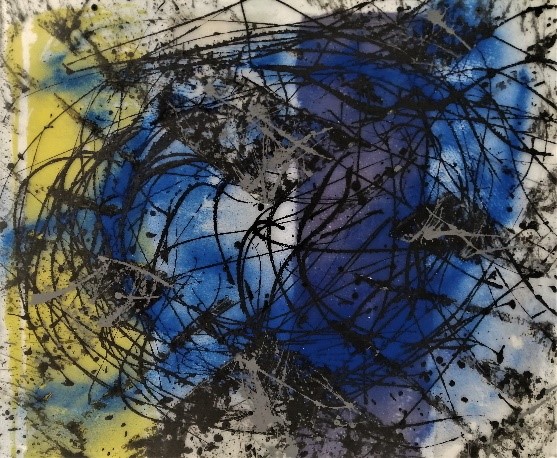
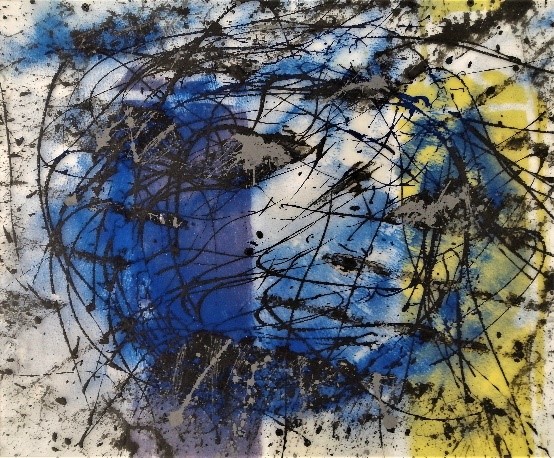
| dc.description | Mix media on persplex using drip technique painting | en_US |
| dc.description.abstract | The green works artwork brings circular and linear forms into dialogue, creating a visual language of contrast and connection. The circular lines suggest movement, continuity, and cyclical time, while the linear marks introduce direction, structure, and progression. Positioned alongside one another, these forms generate a shifting balance between fluidity and order. The work invites viewers to consider how different paths, rhythms, and histories can coexist within a single visual field. Whereas the Blue with yellow edged artworks stages a visual dialogue between density and openness, presenting two contrasting but interconnected cores. The first form is compact and dense, suggesting accumulation, pressure, memory, and contained energy. Alongside it, the second work opens outward through gaps, lighter material presence, and permeable space, inviting movement and interpretation. Together, the works consider how inner experience can be both compressed and protected, while also remaining capable of expansion, exchange, and transformation. This is a Mix media art produced using builder’s oxide as a fundamental tool. This body of work is characterised by fluctuations of mood swings, that range from extreme highs (mania) to extreme lows. Keeping in mind that people have different personalities and mood swings. I identified these personalities and associated them with the functionality of the human brain. The brain is the primary organ that makes discretions on how to cope with stress, and recuperation mechanisms, that sometimes lead to physiological instabilities or inabilities. It is incredible to note how the state of personality disorder can be restored for positive outcome through psychological and psychiatric attention. Similar restorative energy can be referenced to human growth whereby human beings stand a chance to have their emotional moods transformed in a positive manner and surpass the mental state of dilution or odd lifestyle. The way the human brain responds to nervous system illnesses including Alzheimer's, Parkinson's disease, stroke, and traumatic brain disorders is through a complex network of interlinked nerve tentacles. These clusters of disorders serve as a reminder of how crucial our biological foundations are to our behaviour. Surprisingly, the human brain deals with processes that have an impact on how humans think, feel, react, and behave. I portrayed these mental processes using multidirectional (lines) to formulate linear networks that emulate multifunctional and multi directional messages. Kietzmann et al. (2019) also relate the human brain to a complex network, which maps how the human brain works. | en_US |
| dc.description.sponsorship | None | en_US |
| dc.language.iso | en | en_US |
| dc.publisher | Unisa Art Gallery | en_US |
| dc.subject | Swings | en_US |
| dc.title | Mood-Swings | en_US |
| dc.type | Image | en_US |
Files in this item
This item appears in the following Collection(s)
-
Art Exhibitions [22]